
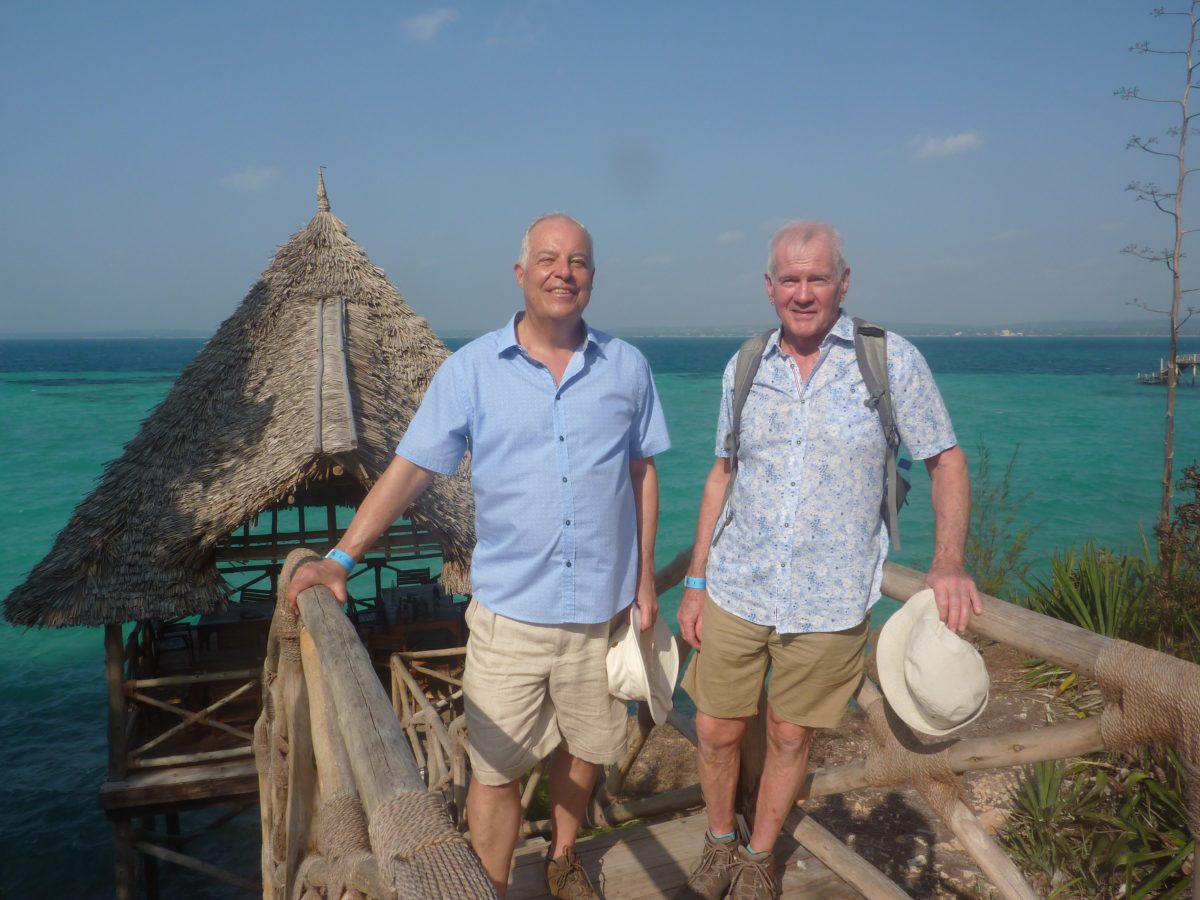
John Good, the former Executive Director of the Community Foundation, doesn’t talk about philanthropy as posture, or performance; he talks about it as a responsibility – sometimes local, sometimes global, always relational. In his telling, giving is not about recognition, it’s about paying attention, building trust, and doing what can be done, even when the need is larger than any one person can solve.
That outlook has deep roots. “It’s really in my DNA,” he says.
Long before he joined the Community Foundation, John inherited a way of seeing the world from his family, especially from his grandmother. Widowed during the Great Depression while raising young children in Toronto, she worked as a welfare officer for the city while living below the poverty line herself. She spent her days visiting families in even harder circumstances, driven by faith and duty, and by what John describes as a genuine love of people.
One family story has stayed with him. His father, still a boy at the time, had a winter hat he adored – the kind with fur trim and big ear flaps. After visiting a family whose children had even less than he did, he wrestled with the decision and finally gave them his hat because “they needed it more than he did.”
John’s grandmother lived that way to the end. She never rose above the poverty line, but she kept giving. She earned a master’s degree in social work, advocated for widows, and in later life helped a Vietnamese refugee family settle in Toronto, helping them find work, register their children for school, and teaching them to navigate the TTC. For John, philanthropy was never just about money, it was also about demonstrating solidarity with other people and doing what one can with what one has.
Before his nonprofit work, John spent much of his career in parks, waterways, and conservation. A turning point came when he received a McConnell Fellowship, which gave him access to a leadership program that affords mid-career professionals a chance to step back, study complex systems, and rethink how change happens.
“I came back from the McConnell Fellowship fired up to change the world,” he says, “but anxious to work at the local level.” He wanted work that produced “tangible and immediate results,” where the effects of good decisions could be felt in real time. The Community Foundation was a natural fit.
When John reflects on what mattered most during his time at the Community Foundation (2014-2021), he doesn’t reach for the numbers first. One moment stays with him. After the Kawartha Muslim Religious Association’s mosque was damaged by fire in 2015, that community found itself with more support than it needed for repairs and security upgrades. At a moment when many of our Muslim neighbours felt vulnerable, they chose not to turn inward. Instead, they created a fund through the Foundation to support women and children through organizations like YWCA Crossroads Shelter and Five Counties Children’s Centre.
“That’s how things are supposed to work,” John says. “Not charity from above, but a community choosing to transform their pain into generosity.”
Now retired, John always returns to the people who have made a difference in his life and career. It was extraordinary people that shaped one of the most extraordinary chapters in his recent life.
While travelling in Tanzania with his partner, Doug, last year, what began as an exciting adventure turned into something truly frightening. Doug suffered a serious cardiac event, and the two of them found themselves in the care of FAME (Foundation for African Medicine) Hospital in Karatu, which was unlike anything either of them had expected to find. It is a 66-bed district facility built over decades by a couple from California who had changed the course of their lives after their own medical emergency on Mount Kilimanjaro. The hospital began with a mobile clinic and is now one of the largest employers in the region, with nearly 300 staff, 98 percent of them Tanzanian; its focus on maternal and child health has saved countless lives across a vast, underserved area of 3 million, primarily Indigenous, people.
Doug became one of the first cardiac patients treated in the hospital’s newly established emergency department. John still remembers the calm around them as staff worked to stabilize Doug. “They just kept saying to him, ‘relax, everything will be fine.'” The volunteer doctor from Australia who was there helping to set up the ER put it simply: “I’ve treated lots of people in the outback with less than we’ve got here.”
Doug was medevaced to Nairobi for surgery, where the head cardiologist greeted him with a line John hasn’t forgotten: “I need you to know that I’m really happy to have a Canadian patient.” It turned out the doctor had trained in Edmonton, and he was glad to give back to someone from the country that had helped him.
A word John heard repeatedly through the experience also resonated with him deeply – Shukrani – Swahili for gratitude. “It’s come up a lot in the last year,” he says.
What might have remained a frightening travel story became something else because John and Doug decided they couldn’t simply return home grateful but unchanged. They set out to help raise funds for a specialized operating room at the hospital’s maternity centre, so that women with high-risk pregnancies and fragile newborns won’t have to be transferred out of their community. Through Myriad Canada and a network built with trusted allies backed by due diligence, the project came together. Family and friends have already helped raise roughly half of the $125,000 goal.
“Community is what you make of it,” he says. Sometimes that means supporting the Kawartha Youth Orchestra’s Upbeat program, where he volunteers because he believes in what it does for young people. Sometimes it means helping people “halfway around the world.” Both, to him, are part of the same moral life.
Doug and John were in Karatu for only 12 hours, but that was enough. “We’re now corresponding regularly with people we feel we’re on very friendly terms with. We can’t help everybody,” he says, “but here’s a way we can do something that will make quite a difference in a particularly poor and vulnerable community.”
For John Good, philanthropy isn’t a performance of virtue, it’s a way of keeping faith with one another. It asks for resources, yes, but also for humility, patience, and the willingness to notice what is fragile, what is promising, and what might endure if we care for it properly. It asks us to do what we can, where we are, and sometimes beyond.